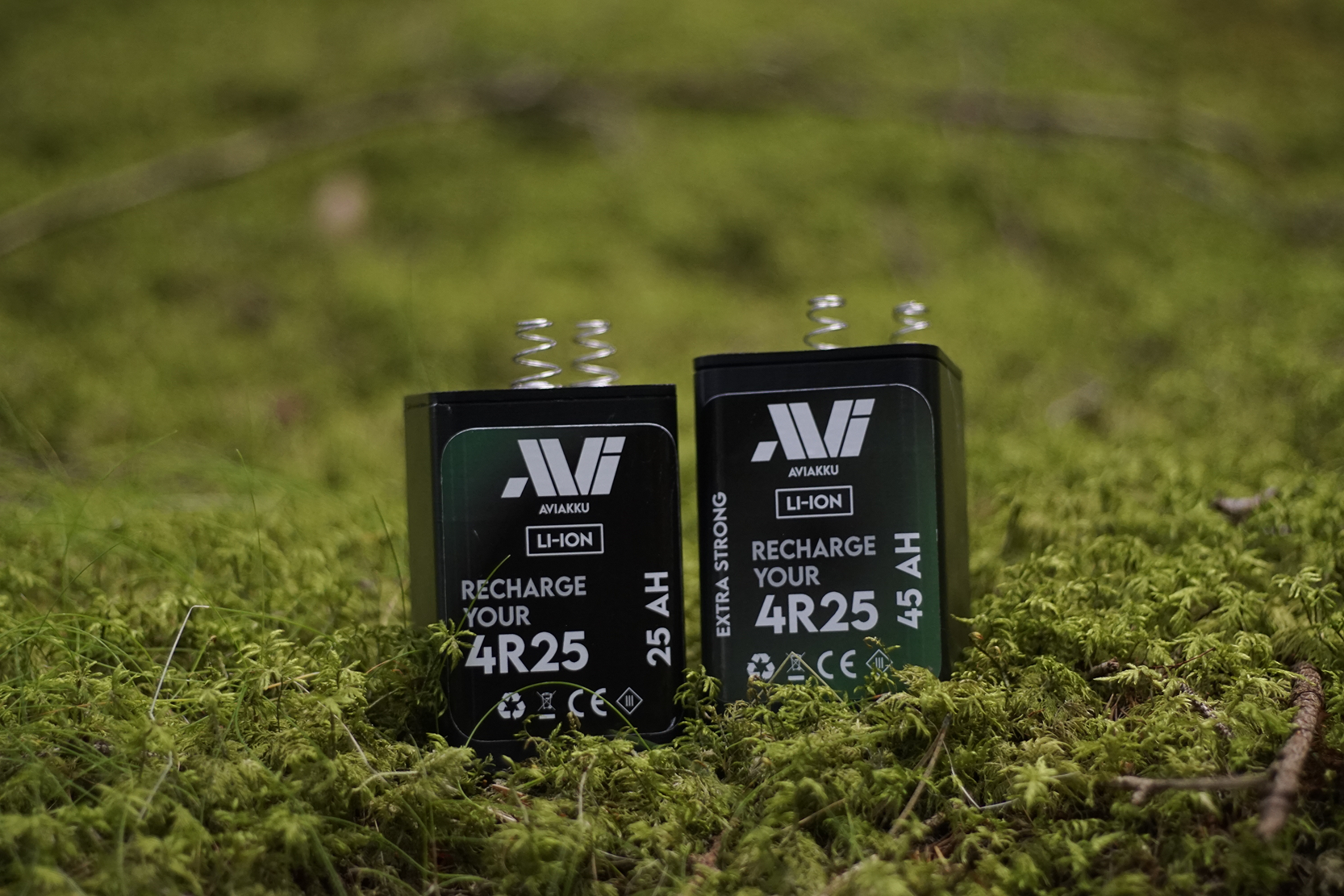
Many people believe that warning lights need a 6V battery such as theclassic 4R25. This sounds logical, but in real use it is not true. What reallymatters is not the voltage written on the battery, but the voltage duringoperation.
A typical 6V disposable battery only reachesthis value without load. As soon as it is used in a warning light, the voltagequickly drops and stays most of the time between about 3V and 4V. This is thereal working range of the light, because the electronics are designed to handlechanging voltage.
A 3.6V lithium ion battery pack in 4R25 formatworks exactly in this range, but in a much more stable way. It starts at about4.2V and stays for a long time between around 4V and 3.2V. This means theenergy is used more efficiently and the light runs more consistently.
The difference becomes very clear in a realtest. Both systems were tested under the same conditions with a constant loadof about 57 mA running all day and night. The result is clear. The 25Ah AVIakkuoutperformed a so called 50Ah zinc air battery. Even with lower nominalcapacity, the battery pack runs longer because its energy stays usable in theimportant voltage range.
In real use, the advantage is even bigger.Warning lights usually only work at night. A lithium ion battery does not losemuch energy during the day, while a zinc air battery continues to dischargeafter activation, even without load. This means it loses capacity during theday without being used. The battery pack instead uses its energy only whenneeded. In practice, this can almost double the effective runtime.
The idea that warning lights need 6V batteriescomes from theory, not from real conditions. In reality, these lights operatemost of the time at lower voltages. This is exactly where a 3.6V battery packperforms best and in many cases it is the better technical solution.


.png)